#206 — What is an agent harness
August 26, 2026·3 min read

Contents
An agent harness is the runtime software and execution scaffolding that transforms a raw Large Language Model (LLM) into an autonomous, task-oriented agent. For startup founders, the harness represents the actual product defensibility layer where business logic, context management, workflow moats, and vendor independence reside.
The core framework
The mental model defining modern autonomous software is simple: Agent = Model + Harness.
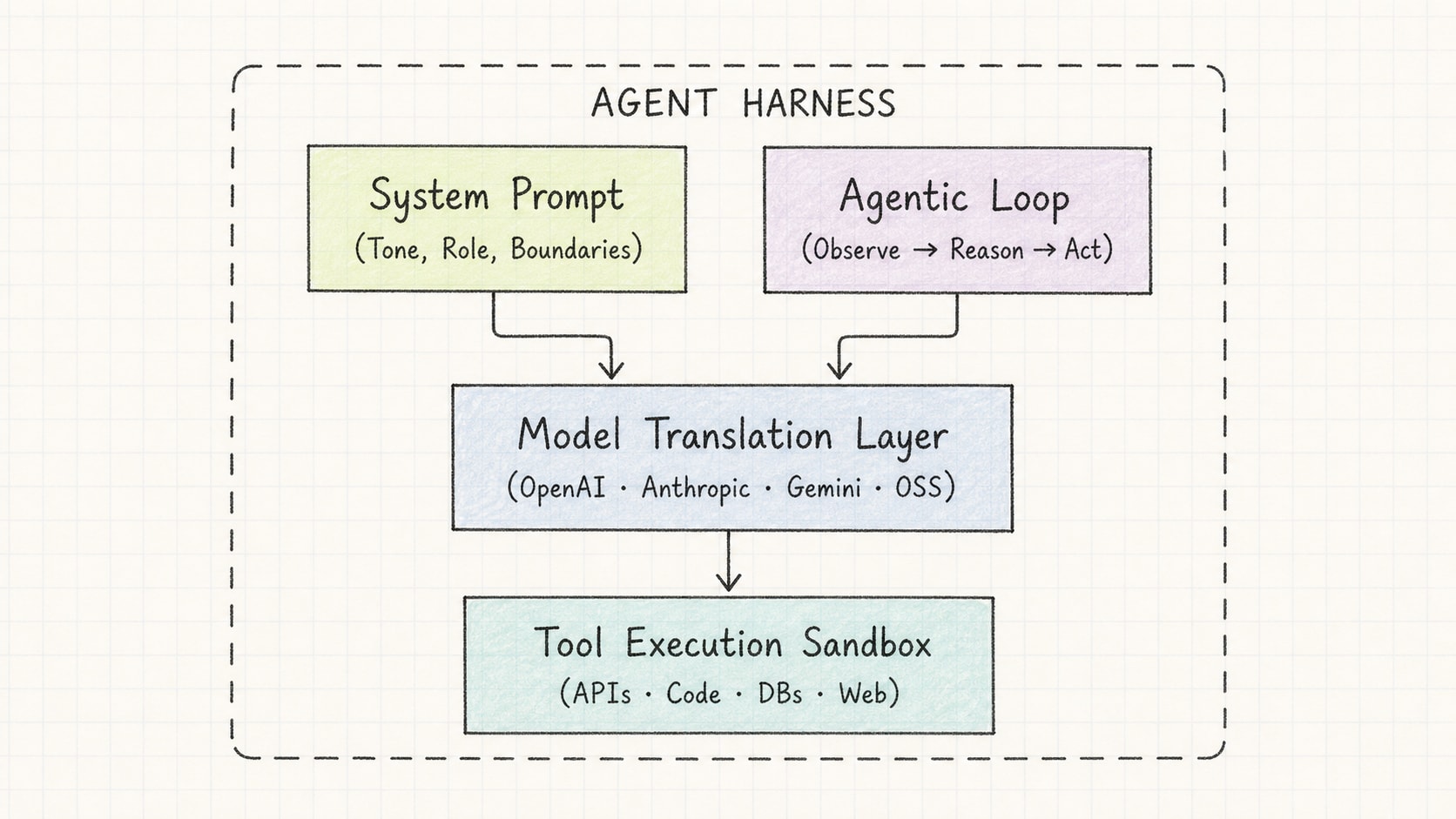
Just as a climbing harness secures a climber to ropes and carabiners to regulate route and safety, an AI harness governs model autonomy, bounds execution parameters, and prevents catastrophic failures.
Why it matters
Building thin wrappers on third-party foundation models exposes startups to commoditization, unhedged API pricing swings, and vendor lock-in.
A proprietary harness separates execution logic from underlying intelligence, allowing teams to treat foundation models as swappable commodities while retaining IP and customer context.
The four architectural pillars
Every production-grade harness manages four interconnected responsibilities:
- System prompts: Defines immutable operational boundaries, user profiles, and behavioral heuristics injected into every context window.
- Tool integration layer: Exposes structured schema definitions and execution sandboxes (e.g., code interpreters, database connectors, or browser drivers) for real-world interactions.
- Agentic feedback loops: Controls multi-turn cycles where the model invokes tools, evaluates intermediate outputs against acceptance criteria, and self-corrects until completion.
- Model translation abstraction: Normalizes input schemas, function call payloads, and token streaming across Anthropic, OpenAI, Google, and open-weight models.
Architectural playbook
| Layer | System Function | Strategic Founder Advantage |
|---|---|---|
| System Prompt | Enforces identity, role constraints, and context injection | Establishes domain guardrails and product voice |
| Tool Execution | Manages sandbox permissions, API calls, and data writes | Builds defensible integrations and workflow moats |
| Agentic Loop | Drives iterative execution, verification, and error recovery | Delivers end-to-end task automation rather than static text |
| Translation Layer | Standardizes multi-provider API calls and token outputs | Optimizes gross margins via dynamic model routing |
Strategic execution rules
Founders building autonomous AI products should follow four core operational principles:
- Own the harness, rent the intelligence: Model capabilities advance continuously, but enterprise stickiness comes from deterministic runtime performance and specialized toolkits.
- Build for multi-model arbitrage: Routing simple tool planning to smaller, low-latency models while reserving frontier reasoning for validation protects unit economics.
- Enforce strict execution bounds: Autonomous loops must implement explicit timeout limits, cost caps, and verification gates to prevent runaway API spend and state corruption.
- Leverage open modular reference designs: Open frameworks such as Pi demonstrate that minimal, extensible harness primitives outperform bloated end-to-end proprietary platforms.
The bottom line
Foundation models provide the engine, but the harness is the steering wheel, safety system, and chassis. Winning AI startups will not be defined by which frontier model they call, but by the robustness and autonomy of the harness they build around it.
Frequently asked questions
What is the difference between an AI agent framework and an AI agent harness?
A framework (like LangChain, CrewAI, or LlamaIndex) provides opinionated, heavy abstractions for chaining calls, whereas an agent harness (such as Pi or OpenClaw) is a lightweight, decoupled runtime environment. The harness manages four specific layers: runtime system prompts, isolated tool execution sandboxes, multi-turn self-correction loops, and a model translation layer without dictating rigid pipeline logic.
How does building a custom agent harness create a defensible startup moat?
Raw model access is commoditized utility; defensibility lives in your execution harness and proprietary feedback loops. Companies like Cursor and Devin built durable moats not by training frontier models from scratch, but by engineering deep IDE sandboxes, custom linters, deterministic evaluation gates, and multi-file mutation environments that generic foundation models cannot replicate on their own.
How do agent harnesses reduce API inference costs and protect gross margins?
Production harnesses use a model translation layer to perform dynamic multi-model task routing. For example, a harness can route routine tool classification and regex validation to open-weight models (like Qwen or Llama running on vLLM/Groq) at under $0.15/M tokens, while reserving frontier models (like Claude 3.5 Sonnet or GPT-4o) strictly for high-ambiguity planning, reducing blended inference costs by 60% to 85%.
What is an agentic feedback loop and how does it prevent agent hallucination?
An agentic loop is an autonomous Observe → Reason → Act → Verify runtime cycle where the model self-corrects based on real tool output. In platforms like Lefos or Pi, when an agent writes invalid code or retrieves incomplete search data, the harness feeds the execution error back into the context window, prompting the model to re-try or revise its strategy until test criteria pass.
Should startups build a proprietary agent harness or adopt open-source harnesses like Pi or Hermes?
For general scaffolding (CLI, terminal execution, standard tool protocols), adopt minimal open-source harnesses like Pi, OpenClaw, or Hermes to accelerate time-to-market and avoid reinventing multi-provider translation layers. Only build custom harness components for proprietary domain logic—such as sandboxed code execution, private database connections, and specialized domain heuristics.
How do agent harnesses solve enterprise data privacy and model lock-in risks?
By decoupling the runtime environment from foundation model APIs, an agnostic harness ensures your startup never depends on a single vendor's proprietary ecosystem (e.g., OpenAI Assistants API). Running a localized, open-source harness allows enterprise customers to keep conversation sessions, embeddings, and sensitive tooling permissions entirely on-premise or within isolated VPCs.
What is an AI agent harness?
An agent harness is the runtime software environment and execution scaffolding that powers an AI agent by wrapping a foundation model. While the model provides raw cognitive reasoning, the harness provides the four core operational layers: dynamic system prompts, tool execution sandboxes, multi-turn agentic feedback loops, and a multi-provider translation layer.
What is the difference between an AI agent framework and an AI agent harness?
Frameworks (such as LangChain, CrewAI, or LlamaIndex) offer opinionated abstractions, pre-built chain pipelines, and prompt graphs. In contrast, an agent harness (such as Pi, OpenClaw, or Hermes) is a lightweight runtime engine that provides isolated tool execution sandboxes, raw agentic loops, and model-agnostic routing without imposing rigid pipeline constraints.
Why do startup founders need a proprietary agent harness instead of relying on foundation lab APIs?
Relying strictly on closed-lab assistants (like OpenAI Assistants API) creates platform lock-in and margin vulnerability. Owning the harness layer enables founders to retain proprietary customer context, maintain local interaction history, implement custom sandboxed tools, and hot-swap between frontier models and low-cost open-weight models as pricing and benchmarks shift.
How does an agentic feedback loop work in production?
An agentic loop operates through a continuous Observe → Reason → Act → Verify cycle. When an agent executes a tool (e.g., querying an SQL database or running code in a sandbox), the harness feeds intermediate errors or execution outputs back into the model context. The model inspects the results and iterates until validation criteria pass before closing the loop.
How do agent harnesses optimize AI unit economics and inference costs?
Modern harnesses utilize a model translation layer for dynamic cost-per-task routing. A harness can route low-complexity tasks (like schema validation or basic tool calling) to open-weight models running on vLLM/Groq at pennies per million tokens, while reserving expensive frontier models (such as Claude 3.5 Sonnet or GPT-4o) for high-order synthesis, cutting blended inference spend by 60% to 85%.
What are the best open-source agent harnesses available today?
Leading open-source harnesses include Pi (a minimal, highly extensible terminal and CLI coding harness from Earendil), OpenClaw (which supports multi-modal UI channels like iMessage and chat apps), OpenCode, and Hermes. These neutral open-source tools contrast with closed harnesses like early Claude Code by providing model-agnostic translation layers out of the box.
How do agent harnesses handle security, sandboxing, and data privacy?
A well-architected harness executes unvetted agent commands inside isolated sandboxes (Docker, WebAssembly, or microVMs) to prevent local filesystem corruption or unauthorized network access. Because open harnesses can run entirely on self-hosted infrastructure or VPCs, enterprise data, session histories, and proprietary tool definitions never leak to third-party model providers.
What is the difference between a model's system prompt and an agent harness system prompt?
A model's embedded system prompt (or training guidelines, like Claude's soul document) is baked into its weights during alignment. A harness system prompt is dynamically injected on every request, functioning like onboarding instructions that govern specific business logic, role boundaries, and runtime constraints for that specific workflow.
Can an agent harness use multiple AI models within a single task loop?
Yes, advanced harnesses use their translation layer to orchestrate multi-model collaboration inside one agentic loop. For example, a harness can use a fast, lightweight open-weight model to generate search queries and extract data, pass the intermediate code generation to a specialized coding model, and finalize the executive summary using a frontier reasoning model.
Keep reading

#207 — Building vertical AI & AI-native services
LLMs can automate the costly, language-heavy work that dominates professional services, something vertical SaaS never could.

#208 — Seed-strapping: How AI-native startups are rewriting the fundraising playbook
Valuation, headcount, and total funding are traditional startup success markers. But what if that conventional wisdom is a relic of the SaaS era?

#209 — Harness engineering
Harness engineering is the practice of designing the environment, tools, constraints, and feedback loops that surround an AI model.