#197 — The doorman fallacy for founders
July 23, 2026·3 min read
Contents
Why it matters: Founders keep automating jobs down to their obvious function, then get surprised when cutting the "obvious" part destroys value nobody was tracking.
The Big Picture
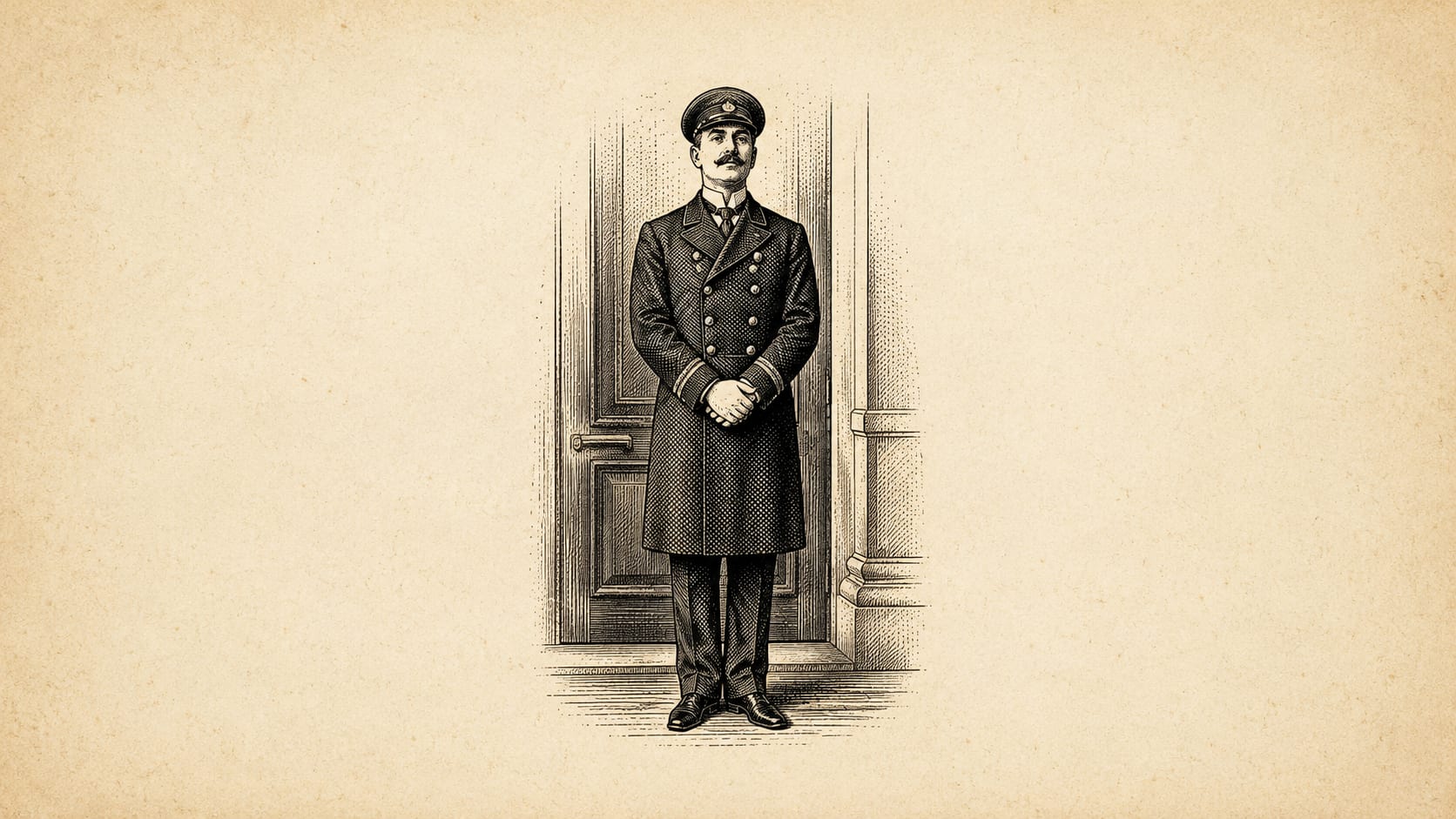
Rory Sutherland named this in his 2019 book Alchemy, using a hotel doorman as the example. Swap him for an automatic door and you save on payroll, but you also lose everything else he was doing that never showed up on a job description.
What the Doorman Actually Did
Hotels assumed the job was "open the door." Sutherland points out three things doormen did that nobody accounted for:
- Guest recognition — remembering names and faces, building the kind of loyalty repeat visits depend on.
- Security — a person standing there deters theft and disorder in a way a sensor can't.
- Status signaling — a uniformed doorman tells guests something about the hotel that a motion detector never will.
The Cautionary Case Study
Commonwealth Bank of Australia laid off 45 customer service staff in 2025 and replaced them with an AI voice bot. Union pressure forced a reversal, and the bank admitted it "did not adequately consider all relevant business considerations and this error meant the roles were not redundant". Support reps do more than close tickets — they build trust, catch problems before they escalate, and protect the brand in ways that never show up in a ticket count.
Why This Matters Right Now
Generative AI has made this the standard explanation for why automating "obviously replaceable" jobs keeps backfiring. The article links it to the ethics of artificial intelligence, since the fallacy sits right at the intersection of cutting costs and causing damage nobody measured.
Founder Playbook: Before You Automate
- List everything the role produces, not just the ticket. Direct output and indirect output both count before you decide what an agent replaces.
- Split signal from function. A role communicates trust and safety on top of doing the task — AI usually only copies the task.
- Plan for reversal risk. Commonwealth Bank shows the cost of getting this wrong isn't just PR damage — it's walking the whole thing back in public.
- Don't stop at "cheaper." A substitute only wins if it beats the total value of what it replaces, not just the line item you cut.
- Scope automation around hidden value, because that's the exact blind spot that keeps tripping up decision-makers.
Frequently asked questions
What is a real-world example of the doorman fallacy beyond the hotel analogy?
Klarna cut 700 customer service roles for AI chatbots in 2023, then reversed course in 2025 after service quality dropped and customers complained about losing human support. CEO Sebastian Siemiatkowski admitted AI handled speed but missed empathy, so Klarna rehired remote human agents in a hybrid model .
Why did McDonald's cancel its AI drive-thru rollout?
McDonald's ended its three-year AI drive-thru trial with IBM in 2024 after viral ordering errors, including a customer receiving 260 McNuggets by accident. The visible task (taking orders) was automatable, but the invisible function—reading context, correcting mistakes, and de-escalating confused customers—wasn't .
How do I know if a role in my startup is safe to automate?
Map every output the role produces, not just its primary task, then ask whether AI can replicate the indirect functions like trust-building, escalation judgment, or brand signaling. If those hidden outputs disappear, expect churn or reputational cost even if the automated version is cheaper and faster on paper.
What industries are most at risk of falling for the doorman fallacy in 2026?
Customer service, tech support, and white-collar knowledge work are the biggest risk zones, with over 120,000 tech roles cut in 2026 partly citing AI, according to Layoffs.fyi. Companies like Oracle and Microsoft have made major AI-linked cuts, but reversals like Klarna's and Commonwealth Bank's suggest many of these decisions underestimated latent value .
Is the doorman fallacy the same as automation bias?
No—automation bias is trusting an automated system's output too readily, while the doorman fallacy is a category error in job design: reducing a complex role to one visible function before deciding to automate it. The doorman fallacy happens before automation; automation bias happens after, once the system is in use .
How should founders evaluate AI cost savings against the doorman fallacy?
Don't compare AI cost to salary alone—compare it to total value created, including retention, trust, and escalation handling that don't show up on an invoice. Klarna's reversal shows the true cost of getting this wrong: rehiring humans after already absorbing the reputational hit of degraded service .
Are companies actually reversing AI-driven layoffs, or is this rare?
It's happening often enough to be a pattern: Klarna, Commonwealth Bank of Australia, and McDonald's all walked back AI-first bets after real-world performance gaps emerged. Commonwealth Bank explicitly admitted the cut roles "were not redundant" after union pressure forced a review .
What's the difference between the doorman fallacy and the Jevons paradox in AI adoption?
The doorman fallacy is about underestimating hidden value in a role before cutting it, while the Jevons paradox describes how making a resource (like AI compute) cheaper can increase total usage and cost rather than reduce it. Founders can fall into both: cutting support staff for AI (doorman fallacy) while AI usage costs balloon unexpectedly (Jevons paradox).
Who coined the term doorman fallacy and where does it come from?
Advertising executive Rory Sutherland coined the term in his 2019 book Alchemy: The Surprising Power of Ideas That Don't Make Sense, using a hotel doorman replaced by an automatic door as the founding example .
What is a category error, and how does it relate to the doorman fallacy?
A category error is a logical mistake where something is treated as belonging to a category it doesn't fit—in this case, treating a multi-function human role as if it were a single, isolated task. The doorman fallacy is a specific, named instance of this broader logical error applied to job automation decisions .
How many white-collar jobs are actually at risk from AI automation?
Economists cited by CNBC in October 2025 warned there's "much more in the tank" for AI-driven white-collar job losses, signaling this trend is still accelerating rather than plateauing. The doorman fallacy is increasingly used as the explanatory framework for why many of these cuts backfire .
What's the connection between the doorman fallacy and AI ethics?
Wikipedia lists Ethics of artificial intelligence as a directly related topic, since the fallacy sits at the intersection of cost-cutting decisions and unintended organizational or social harm. Founders deploying AI agents face the same ethical tension: optimizing for a visible metric while degrading trust, safety, or fairness that isn't measured .
How does signaling theory explain why the doorman fallacy happens?
Signaling theory holds that certain behaviors or presences (like a uniformed doorman) communicate information—status, trust, security—independent of their direct function. Decision-makers who only measure observable tasks miss these signals entirely, which is exactly the blind spot behavioral economics identifies in this fallacy .
Is 'doorman fallacy' the official Wikipedia term, or is it known by another name?
Doorman fallacy is the term used on Wikipedia and in Sutherland's original writing, and it falls under the categories of Fallacies, Neologisms, and Automation. It's a relatively new coinage (2019), so search variants like "AI doorman problem" or "automation doorman effect" refer to the same concept .
What roles are most vulnerable to the doorman fallacy when startups adopt AI agents?
Customer-facing and judgment-heavy roles are highest risk—support reps, account managers, and front-line ops staff—because their value is disproportionately in soft outputs like trust and escalation handling rather than task throughput. Founders building agentic systems should audit these roles first before scoping automation .
Keep reading

#198 — Open source AI in 2026: The founder briefing
Open weights now match closed models on most everyday tasks and cost 50x less than three years ago — but the real fight has moved to the agentic harness.
#199 — Building blocks, workflows, and agents
In the wild, successful agent implementations usually involve use simple, composable patterns rather than complex frameworks.

#200 — Prompting Claude Code and Fable 5 with clarity
The bottleneck is your clarity, not the model. The gap is between your instructions and what needs to happen is now the thing slowing you down.