#137 — Navigating founder-led sales
November 11, 2025·7 min read

Contents
Why it matters
No one knows your product's problem space better than you. Being your startup's first seller builds strategic muscle for scaling your entire GTM organization—and prevents sales from becoming a "black box" that dictates product strategy.
The big picture: Most founders avoid sales because they think it requires charm and persuasion, but it's actually about pattern-matching, searching for the right customers, and debugging conversations—skills founders already have.
The Business Case for Founder-Led Sales
What you gain
- Headcount efficiency: Save budget by not hiring a first seller
- Unparalleled expertise: You have deeper passion for solving domain problems than any hired rep
- Strategic foundation: Learning to sell now builds the DNA for hiring, delegating, and managing future sales teams
- GTM intelligence: Understand exactly how to hold sales accountable when you scale
Why PLG startups still need this
Even freemium, bottom-up companies eventually need top-down sales. When that happens, founders who never learned to sell often hand over complete authority to sales executives—creating 9-18 month blind spots before discovering if they hired the right leader.
The 3Ws Framework: First Principles for Sales
Created by Oracle sales veteran Steve Browne (who reverse-engineered why top performers only spent time on deals that would actually close), the "3Ws" reduce all sales conversations to three fundamental questions:
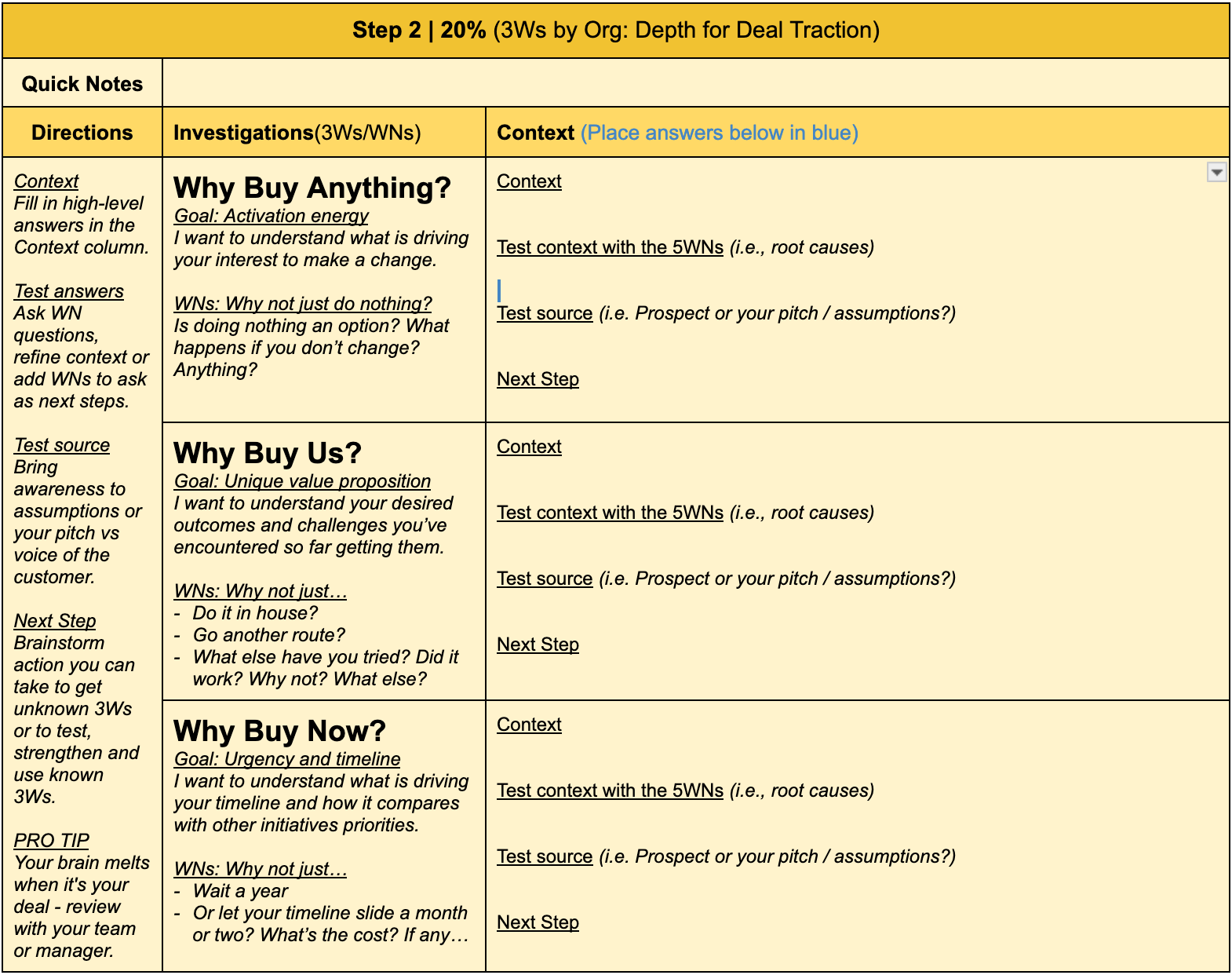
1. Why Buy Anything?
Is the pain severe enough to warrant change, or is "doing nothing" acceptable?
What to test: Did they explicitly tell you they'd lose money/their job/customers without solving this? How much would they lose?
2. Why Buy Us?
Why your solution versus competitors or building in-house?
What to test: Can you articulate your unique value in the prospect's own words, not just feature comparisons?
3. Why Buy Now?
What's the cost of waiting until next quarter or next year's budget?
What to test: Does the timeline alignment come from someone with budget authority, or just a champion without power?
Origin story: Browne joined Oracle in 1987 as an engineer, learned salespeople made 5x his salary, and became a solution engineer to study why deals closed or died. His 3Ws framework now underpins modern sales methodologies like MEDDIC.
Breaking Through Mental Blocks
The limiting beliefs that sabotage founders
Many founders stop short in sales conversations due to unconscious patterns:
- "I don't want to bother people"
- "I can't ask direct questions—they'll hang up"
- "This feels too pushy"
- "I need to show more product features first"
- "Asking too many questions will ruin the relationship"
Reality check: These may be maladaptive patterns developed in childhood to avoid rejection. When prospects pause or react unexpectedly, founders interpret it as disapproval rather than an opportunity to find alignment.
How to reframe discovery questions
Old belief: "Asking questions is annoying and sales-y"
New belief: You're conducting a search for people suffering in the exact way your product was built to cure. If there's no fit, you'll be the first to tell them—preventing the suffering of selling something they don't need.
Three core values that replace fear
- Compassion: You're trying to end developer suffering, not create it
- Curiosity: Root cause analysis to quantify pain and find impacted stakeholders
- Collaboration: Make conversations back-and-forth, not product demos that dominate airtime
Pro tip: Founders who identify their self-limiting beliefs and triggers often go from "hating sales" to loving it almost instantly. Some founders use this as a "welcome mat for therapy" to perform functional analysis on what beliefs are blocking them.
The Deep-Wide-High Discovery Method
Don't just ask the 3Ws—ask them with enough specificity:
Deep Enough
- Are issues quantifiable?
- Is there enough pain to warrant making a change?
- What happens if they don't solve this? (And did they actually tell you that, or are you assuming?)
Wide Enough
- Who are ALL the people impacted?
- What are second-order impacts?
- Who are the champions within the organization?
High Enough
- Have you mapped the power structure?
- If something blocks the prospect, who has authority to escalate?
- What's the escalation plan?
How to use it: This is iterative. You might make traction with developers, then conversations move to procurement and blow up—that's good signal. You've identified where you're NOT fully resourced yet, so focus your next session on those blockers.
Investigating Deals Like a Detective
Grade deals by completion percentage
Track pipeline with these "investigation" milestones:
- 20% complete: Have 3Ws for the organization
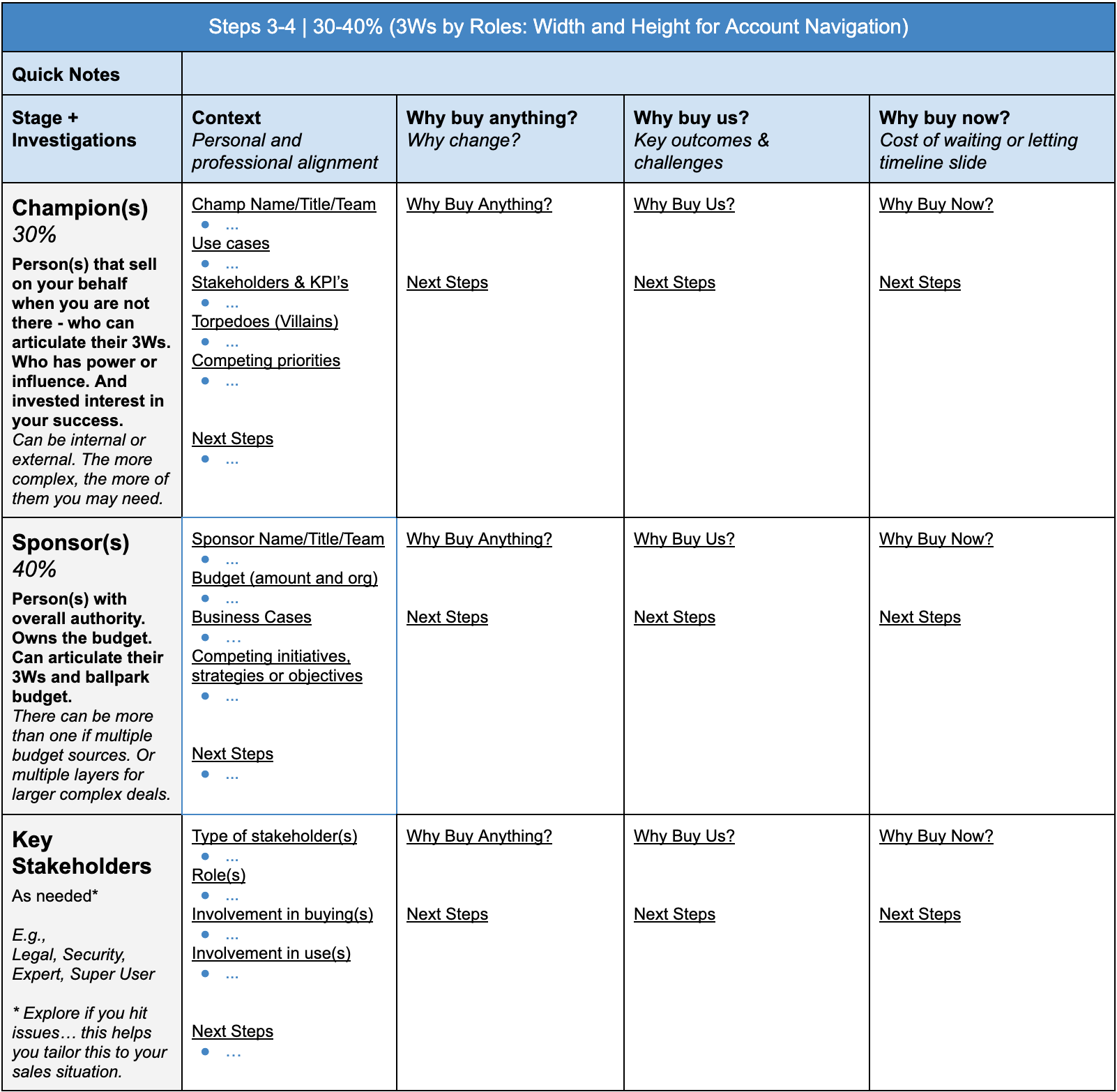
- 30% complete: Identified a champion with power (not just a contact)
- 40% complete: Have 3Ws in the words of the sponsor (person with budget)
- 50% complete: Developed a plan based on 3Ws; have competitor map if needed
Run deal reviews with these questions
Ask sequentially to build "muscle memory" for ~1-minute updates per deal:
- Deal details (amount, close date, stage)
- What changed since last review?
- What's the next step?
- What's the biggest concern/challenge?
Start with the biggest concern—this identifies which cases to investigate first.
Investigate stuck deals with "Why Not" questions
Test assumptions by examining the opposite of each W:
- Deal stuck at 30%? Ask: "Why wouldn't they just keep everything the same?" If they say "they won't make money," ask: "How much would they lose before they'd actually do something?"
- Prospect went dark? That's weak "Why Buy Now"—they probably lack a sponsor with urgency
- Timeline slipped? You might only have a champion, not someone who can escalate
Goal: For every deal won or lost, know exactly why. Early startup pipeline won't be a repeatable flywheel—your job is identifying what makes winners win so you do more of that.
Your CRM Must Track These Fields
Display sequentially for pipeline reviews:
- Deal amount
- Close date
- Stage (% completion)
- What changed since last review
- Next step
- Biggest concern/challenge
- 3Ws for organization
- 3Ws for champion
- 3Ws for sponsor (budget holder)
Qualification checkpoint: One of your most important early tasks is determining if prospects fit your ideal customer profile (ICP). If not, end the conversation ASAP—this creates a feedback loop to refine your target persona.
How Being First Seller Sets You Up to Scale
When hiring your first sales team
What to watch for: Many reps from high-ARR, strong product-market-fit companies don't actually know how to sell with precision. They rode existing momentum. As a founder selling into an unknown market, you must be more rigorous.
Red flag: Sales executives who demand: "Give me authority to do whatever I want and hire whoever I want, and don't attend pipeline meetings". This turns sales into an inscrutable black box where you wait 9-18 months to learn if you hired wrong.
What you can do instead
- Build your own sales roadmap: Define the sales leader profile you want
- Create the space for delegation: Know how to talk with sales teams and see their "typical hiding places"
- Implement understandable metrics: "Investigation" activities from day one using frameworks you built yourself
- Call the tune on enablement: Control what helps sellers sell instead of letting sales dictate product strategy
The bottom line: Sales shouldn't wag the dog. Figure out if your sales team is working in one session or a quarter of weekly pipeline reviews—it's usually quick when you have firsthand selling experience.
Resources and Templates
3Ws for the organization
3Ws by role
The Transformation
What founders discover: The same skills that made you successful at product, project management, and innovation make you successful at sales. You don't need a "sales persona" with a fast car and power tie—just show up as yourself with a process.
The unlock: When founders understand the 3Ws and practice "deep-wide-high" discovery, they become as good at sales as the first reps they hire. Even those who "hate" sales usually become fans once they connect it to first principles thinking.
Frequently asked questions
When should I hire my first sales rep as a technical founder?
Wait until you're spending 30-40% of your time on sales and have closed 10-25 customers yourself. Hiring too early costs $400K-$800K in fully loaded costs and 6-12 months of lost momentum. One Series A CEO who waited until he spent only 25% of his time on sales had his first VP productive in 47 days, while another founder at 75% sales time saw their VP take 6 months and still couldn't close without help.
What's a realistic close rate for founder-led sales in B2B SaaS?
For founder-led B2B SaaS, expect SQL to closed-won rates of 20-25% overall. However, founders typically outperform early sales hires because of deep domain expertise—many achieve 30-40% close rates on qualified deals. Your MQL-to-SQL conversion (where qualification happens) should be 35-45%.
How long should my B2B SaaS sales cycle be as a founder?
SMB deals under $5,000 average 30-90 days with a median of 40 days. Mid-market deals ($5K-$50K) typically take 84 days, while enterprise deals extend to 6-9 months. Deals under $2,000 should close within 14 days ideally as 1-2 call closes. The optimal sales cycle is 46-75 days, balancing deal value with velocity.
Should I do discovery and demo on the same call or separate calls?
Always separate them into at least 2 calls minimum. Running discovery first shows buyers you understand how to help them and lets you tailor the demo to their specific pain points. If prospects push back, say: 'Many groups find a 20-30 minute chat beforehand helpful to make sure you won't waste your team's time when we demo. Does that sound fair?'.
What's the difference between a champion and a sponsor in enterprise sales?
A champion enthusiastically sells you when you're not in the room but lacks budget authority. A sponsor (or economic buyer) has budget authority and decision-making power. Champions can get you access to sponsors and will help you sell internally, but deals can't close without sponsor buy-in. According to the 3Ws framework, you need 3Ws from both the champion (30% deal completion) and the sponsor (40% completion).
What CRM should technical founders use for founder-led sales?
For 2-10 person teams or founder-led sales, Pipedrive offers the most intuitive pipeline UI with solid automations for small teams. HubSpot is best if you need marketing automation alongside sales. Both let you track the essential fields: deal amount, close date, stage completion %, 3Ws for organization/champion/sponsor, next steps, and biggest concern. Avoid Salesforce until you have dedicated sales ops—it's over-engineered for early-stage.
How do I know if a prospect is just tire-kicking versus actually buying?
Test for weak 'Why Buy Now' by asking: 'What happens if you wait until next quarter's budget?'. Real buyers will articulate specific costs of delay (lost revenue, competitive disadvantage, team attrition). Tire-kickers say 'We're just exploring options' or can't quantify pain. Also test if they have a sponsor with budget authority (not just a champion) and if the timeline comes from someone with power. If prospects go dark, it's usually weak urgency or lack of a real sponsor.
How much of my time should I spend on sales as a pre-seed or seed founder?
Early on, expect to spend 50-75% of your time on sales until you have repeatable process. The ideal time to hire your first sales leader is when you're down to 30-40% of your time on sales—you've systematized enough that someone else can run the machine, but you're still close enough to coach them. Below 25% and you risk not being able to properly onboard; above 50% and you're not building enough product or operational infrastructure.
What are the warning signs I hired the wrong first sales leader?
Red flags include: demanding 'Give me authority and don't attend pipeline meetings' (creates 9-18 month black box), can't close deals without you on every call after 3+ months, came from high-PMF company and rode momentum rather than learned to sell with precision, or can't articulate why deals are won/lost using your qualification framework. Average time to figure out it's not working: 4-6 months, but founders wait 9-12 months to actually make the change.
What metrics should I track in my CRM as a founder doing sales?
Display these fields sequentially for pipeline reviews: deal amount, close date, stage (% completion using 20%/30%/40%/50% milestones), what changed since last review, next step, biggest concern, 3Ws for organization, 3Ws for champion, and 3Ws for sponsor. Track pipeline velocity (target $743-$2,456/day depending on your segment) and maintain ≥3× pipeline coverage. Your biggest bottleneck will be MQL→SQL conversion at 15-21%—this is where qualification using the 3Ws matters most.
Should I use BANT or MEDDIC for sales qualification as a founder?
Use BANT (Budget, Authority, Need, Timeline) for simpler SMB deals under $10K with short cycles. It's fast and focuses on purchase readiness. Use MEDDIC (Metrics, Economic Buyer, Decision Criteria, Decision Process, Identify Pain, Champion) for enterprise deals over $50K with complex buying committees. MEDDIC is more thorough and helps you track deal progression—think of it as 'hard mode' versus BANT's 'easy mode'. For most technical founders, start with the 3Ws framework (which is simpler than both) then layer in MEDDIC elements as deals get more complex.
What response rate should I expect from cold emails as a B2B SaaS founder?
Industry benchmarks for well-targeted cold emails are 14-23% response rate. However, most founders start at 1-5% with generic outreach. One B2B SaaS founder went from 0% response rate on 15K emails to 6% reply rate and 23 meetings by making three changes: targeting UK mid-market e-commerce specifically (not generic blasting), using outcome-driven language instead of features, and offering low-commitment CTAs instead of 'let's hop on a call'. This generated €184K in pipeline value in 3 months.
How much equity should I give my first sales hire?
First sales hires (typically AEs, not VPs) get 0.5-4% equity with a median of 1.49%. Sales VPs at seed stage typically receive 0.5-1.5% depending on whether they're your first GTM executive. The most generous founding teams (90th percentile) grant their first five hires combined 17.56% of the company; conservative teams grant 1.32%. For founding employees joining at high risk, 1-3% per person is common for the first five hires. Remember to tie equity to 4-year vesting with a 1-year cliff.
How should I handle pricing objections without discounting immediately?
Research shows 48% of B2B deals end in 'no decision' with pricing as the primary contributor. Before discussing price, establish value—teams that do this achieve 30% higher close rates and maintain pricing power. When objections arise, use the contrast framework: 'I understand the $120K investment seems significant. However, when we consider our solution reduces churn by 15%, which for your organization represents $750K in retained annual revenue, you're seeing a 6:1 return'. Then ask: 'Compared to what?' to uncover if this is really a price issue or a value communication gap.
When should I give discounts as a founder selling B2B SaaS?
Establish clear discount authority levels: reps can approve 5-10% discounts, managers 20%, and anything larger requires executive approval. Best practice discount triggers: 10% for annual prepayment, additional 5% for 2-year commitments, and 5% for public case study agreement (maximum 15-20% stackable). Never discount without getting something valuable in return—longer commitment, upfront payment, case study rights, or reference customer status. Document every discount reason in your CRM to identify patterns.
What is multithreading in sales and when should founders use it?
Multithreading means building relationships with 6-10 stakeholders across different departments rather than relying on one champion. Enterprise deals now involve 6-10 decision makers on average, sometimes up to 20. Companies leveraging multithreading strategies will grow revenue 50% more than single-threaded competitors by 2026. Start multithreading any deal over $25K by asking your champion: 'Who else is impacted by this problem?' Then get introduced to finance (ROI concerns), IT (technical requirements), and operations (usability). This is 'wide enough' discovery in the deep-wide-high framework.
Why do so many of my qualified deals end in 'no decision' and how do I prevent it?
60% of pipeline deals are lost to 'no decision' rather than competitors, and for enterprise software this often exceeds 40%. No-decision losses primarily signal weak 'Why Buy Now' (lack of urgency) or missing economic buyer buy-in. To prevent this, quantify the cost of waiting during discovery: 'How much will you lose each month if this problem continues?'. One company reduced their no-decision rate from 65% to 28% by breaking implementations into phases, addressing the 'this seems too risky/complicated' concern. If deals go dark, they likely lack a sponsor with budget authority—go back and test if you have the 'high enough' stakeholder.
What sales enablement materials should founders create before hiring sales reps?
Build these core assets before your first sales hire: buyer personas with pain points and 3Ws, demo scripts organized by use case (not just feature tour), proposal templates with ROI calculators specific to your ICP, objection handling guide covering top 5 objections with responses, call recording library of your best discovery calls and closes, and one-pagers for each key use case. Sales reps spend 30 hours per month searching for or creating content if you don't provide this. Organize materials by sales stage so reps can quickly find what they need for each conversation.
How accurate should my sales forecasts be as an early-stage founder?
Traditional forecasting methods achieve 15-40% MAPE (Mean Absolute Percentage Error), while ML systems reach 5-15% MAPE. For early-stage founder-led sales, aim for ±20% accuracy month-to-month as you won't have enough historical data for statistical models. Track forecast accuracy by deal stage—deals at 50% completion (with documented plan and sponsor 3Ws) should have 60-70% close probability. Just 15% forecast accuracy improvement delivers 3% pre-tax profit improvement. The key is knowing exactly why each deal won or lost so you can refine your qualification criteria.
What are the biggest mistakes founders make when doing sales themselves?
The top mistakes include: leading with product demos instead of discovery (violates 'deep enough' principle), asking surface-level questions then assuming pain instead of hearing prospects quantify it, working only with champions and never reaching economic buyers (deals stuck at 30% completion), giving discounts without getting commitments in return, avoiding direct questions due to fear of 'bothering' prospects, and not documenting why deals win/lose so the pattern never becomes repeatable. The psychological block founders face most: interpreting prospect pauses as rejection rather than thinking time.
Keep reading

#138 — The Morando Method: How technical founders "ship revenue"
The methodology helps technical teams gain structure, speed, and simplicity in the sales process and close their first contracts.

#139 — The do’s and don’ts of founder-led sales
Every early-stage startup inevitably goes through a period of founder-led sales but it can be difficult to know where to start.

#140 — 3 GTM communication rules for founders
Startup communications can be complex, but these rules can help you navigate the process from day one and beyond.