#167 — How to grant equity in a Delaware LLC
January 24, 2026·4 min read
Contents
Note: Why incorporate as an LLC over a C-Corp? Read our perspective on why LLCs are better for non-US startups.
Why it matters: Many founders worldwide launch as LLCs for speed and flexibility—but most don't know how to grant equity properly, creating messy cap tables that complicate future fundraising.
The big picture: In an LLC, you issue "units" (not shares), and you need a structured unit incentive plan to compensate team members with equity.
Two Types of Units: Know the Difference
Profits interests only give rights to future appreciation above a threshold—the company's value at grant date.
- No tax liability at grant if structured correctly
- Only participate in value created after the grant date
- Taxed as long-term capital gains (20% max federal rate) vs. ordinary income (37% max)
- Example: If your LLC is worth $10M at grant and exits at $12M, profits interests only share in the $2M gain
The catch: Profits interests require the company to get a 409A valuation to set the liquidation threshold at fair market value.
The Three Required Documents
You can't just issue units informally. Three documents are legally required:
- Updated Operating Agreement that authorizes equity grants and defines member rights
- Equity Incentive Plan establishing the overall framework, pool size, and eligibility
- Individual Grant Agreements for each recipient with specific vesting terms
Red flag: Issuing units without updating your Operating Agreement creates legal conflicts that surface during investor due diligence.
Standard Vesting Structure
The norm: 4-year vesting with a 1-year cliff.
- Nothing vests for the first 12 months
- After the cliff, units vest monthly or quarterly
- If someone leaves before the cliff, they get zero
Acceleration triggers:
- Acquisition or sale of the company (single or double-trigger)
- Termination without cause
- Death or disability
Repurchase rights: The LLC typically retains the right to buy back unvested units at nominal value ($0.001/unit) if someone leaves early.
The 83(b) Election: Don't Miss This Deadline
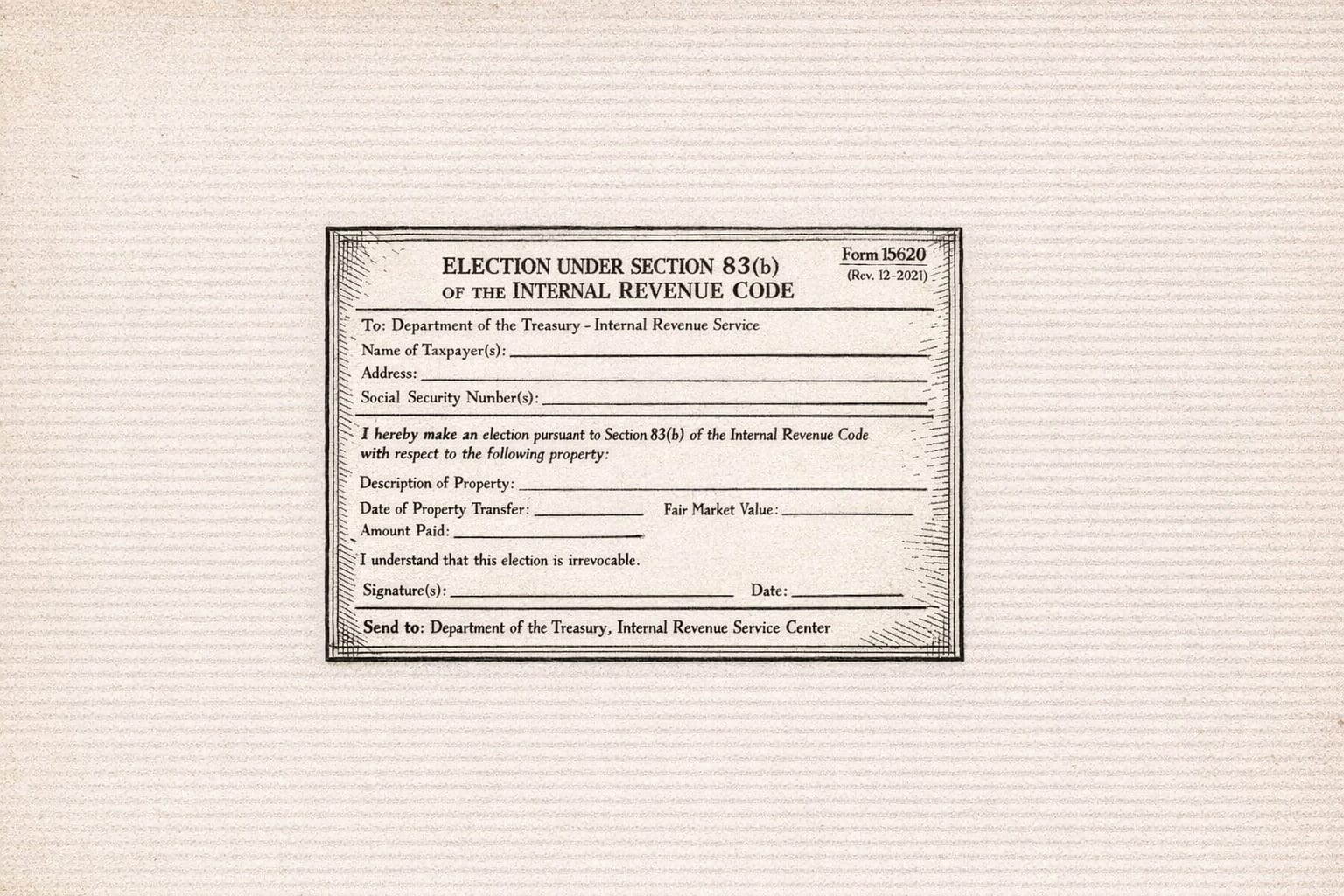
What it is: A one-page IRS form (Form 15620) that lets recipients pay tax on equity at grant instead of at vesting.
Why it matters: Filing 83(b) locks in capital gains treatment and prevents tax liability from ballooning as the company grows.
The deadline: Must be filed within 30 days of the grant date—no exceptions, no extensions.
- This is a statutory deadline; the IRS has zero discretion to grant extensions
- Miss it and your team pays ordinary income tax rates on the full value at vesting
Who files: The recipient, not the company—but founders should track deadlines and confirm filing.
Transfer Restrictions and Controls
Standard provisions:
- Units can't be sold or transferred without company approval
- Right of first refusal (ROFR) in favor of the LLC
- Drag-along rights forcing minority holders to join a sale
- Tag-along rights protecting minority holders in a sale
Why investors care: These restrictions keep your cap table clean and prevent random third parties from becoming members.
Tax Treatment Breakdown
Profits interests (done correctly):
- No tax at grant (value = $0 if properly structured)
- Taxed as capital gains at exit (20% federal max + state)
- Requires 83(b) election within 30 days
Common units:
- Taxed as ordinary income at grant based on FMV
- Recipient owes tax immediately, even without liquidity
- May require 409A valuation to establish FMV
Company deductibility: Profits interests are NOT tax-deductible for the LLC because they're treated as partner income, not employee compensation.
Common Founder Mistakes
What kills deals during due diligence:
- Misstructured profits interests that don't meet IRS safe harbor requirements, triggering ordinary income treatment
- Missing 83(b) elections that double or triple recipients' tax burden at vesting
- Issuing units without updating the Operating Agreement, creating conflicts between the agreement and actual ownership
- No 409A valuation to support the liquidation threshold for profits interests
- Unclear vesting schedules or repurchase rights that create disputes when people leave
When to Get Legal Help
DIY is risky for:
- Structuring profits interests to meet IRS safe harbor rules
- Ensuring your Operating Agreement properly authorizes equity grants
- Setting liquidation thresholds that won't be challenged
- Multi-state or international team members with complex tax situations
The bottom line: A clean cap table isn't optional if you're raising institutional capital. Investors will walk away from messy equity structures.
Pro tip: If you're planning to convert from LLC to C-Corp for a future funding round, design your unit plan with that transition in mind to avoid restructuring headaches later.
Frequently asked questions
Do I need a 409A valuation for my LLC if I'm only issuing profits interests?
Yes. Even for profits interests, you need a 409A valuation to establish the liquidation threshold (the company's fair market value at grant date) and achieve IRS safe harbor protection. Without an independent 409A from a qualified third-party appraiser, your profits interests risk being reclassified as ordinary income rather than capital gains. Most appraisers recommend updating your 409A annually or after material events like fundraising—valuations are considered valid for 12 months.
What happens to LLC units when we convert to a C-Corp for venture funding?
Unit holders typically receive C-Corp shares in exchange for their LLC units at the conversion ratio based on fair market value. However, if you convert shortly after establishing a profits interest plan, participants may lose value because they won't have had time to earn appreciation above the threshold before conversion. For example, if your LLC is valued at $1M when you grant profits interests and convert at $1.2M six months later, recipients only participate in $200K of value growth rather than the full future upside. The conversion also resets the 5-year holding period for QSBS tax benefits.
How large should my LLC equity pool be for hiring employees?
Reserve 10-15% of total company equity for your employee pool before your first institutional funding round. Pre-seed and seed-stage companies often allocate 15-25%, while later-stage companies (Series A+) typically maintain 10-15%. For context: a company valued under $5M might reserve 9-22%, while a company at $50M+ typically allocates 10-15%. Investors will insist this pool is created on a pre-money basis to avoid diluting their ownership post-investment.
Can I grant LLC units to advisors and contractors, or only full-time employees?
Yes, you can grant units to advisors, contractors, board members, and other strategic partners—not just employees. For advisors, typical equity ranges from 0.1-1% with 2-year vesting, depending on their seniority and time commitment. However, you must obtain a 409A valuation before granting advisor equity, and be mindful of cap table dilution. Early-stage advisors providing significant strategic value might receive 0.5-1%, while later-stage advisors typically get 0.1-0.25%.
What are the tax implications if I grant LLC units to foreign team members?
For non-U.S. team members working outside the U.S., your U.S. LLC typically must withhold 30% federal tax on equity compensation income under Section 1441. However, this rate may be reduced if a tax treaty exists between the U.S. and the employee's country. The employee generally must file Form 1040NR for their U.S. tax return. If the foreign team member is a U.S. citizen working abroad, different rules apply under Section 911 foreign earned income exclusion. Consult with international tax counsel as this is a Tier 1 IRS compliance issue.
What's the actual cost to set up a proper LLC unit plan with legal counsel?
Setting up a complete LLC equity incentive plan typically costs $5,000-$15,000 in legal fees, depending on complexity and jurisdiction. This includes drafting the Operating Agreement amendments, Equity Incentive Plan document, and template grant agreements. You'll also need an initial 409A valuation, which costs $2,000-$5,000 for early-stage companies. Budget for annual 409A updates ($1,500-$3,000) and legal counsel review for each major grant ($500-$1,500). While this seems expensive upfront, messy equity structures can kill funding rounds worth millions.
Can I retroactively fix LLC units I already granted without proper documentation?
Partially, but it's complicated and potentially costly. You can retroactively update your Operating Agreement and create formal grant agreements, but you cannot file a late 83(b) election—the 30-day deadline is statutory with zero IRS discretion. Recipients who missed the 83(b) window will face ordinary income tax rates at vesting instead of capital gains. If units were granted below fair market value without a 409A, you may trigger Section 409A penalties (20% excise tax plus interest and state penalties). Work with tax counsel immediately to assess exposure and document what you can salvage.
Should I grant common units or profits interests to early employees?
Grant profits interests to employees in nearly all cases. Common units create immediate tax liability because they represent a share of current company value, meaning employees owe ordinary income tax on the grant even without liquidity. Profits interests have $0 value at grant (no immediate tax), vest over time, and qualify for long-term capital gains treatment (20% max federal rate vs. 37% for ordinary income). For example, if your LLC is worth $2M and you grant 1% common units, the employee owes tax on $20,000 immediately. With profits interests, they owe nothing until exit and only pay capital gains on appreciation above the $2M threshold.
How do I explain the value of LLC units to candidates when making offers?
Convert the unit percentage to potential dollar value using realistic exit scenarios. For example: '1% of the company as profits interests with a $1M threshold. If we exit at $10M in 4 years, your fully vested units would be worth $90,000 (1% of the $9M above threshold), taxed at long-term capital gains rates'. Show 2-3 scenarios (conservative, moderate, ambitious) and emphasize the tax advantages of profits interests vs. common stock. Compare it to what they'd receive at a C-Corp at a similar stage, and explain that vesting protects both parties—they earn equity over time as they contribute value.
What vesting acceleration should I offer in my LLC unit grants?
The market standard is single-trigger acceleration on acquisition (immediate vesting when the company is sold) or double-trigger acceleration (vesting only if acquired AND the employee is terminated within 12 months). Double-trigger is more founder- and investor-friendly because it keeps employees motivated post-acquisition. For key executives, consider 25-50% single-trigger acceleration plus double-trigger for the remainder. Most investors will push back on full single-trigger acceleration because it can reduce acquisition value if the entire team vests and leaves immediately. Acceleration on termination without cause is less common but may be appropriate for senior hires.
Why do venture capitalists prefer C-Corps over LLCs for fundraising?
VCs almost universally require C-Corps because they can issue multiple classes of preferred stock with different rights, preferences, and valuations—the foundation of institutional venture deals. LLCs use a single class of membership units, making it difficult to create liquidation preferences, anti-dilution protection, and board control provisions VCs demand. Additionally, tax-exempt institutional investors (pension funds, endowments) face UBTI (Unrelated Business Taxable Income) complications when investing in pass-through entities like LLCs. If you're planning to raise institutional capital, expect investors to require you to convert to a Delaware C-Corp before they'll invest.
What is the K-1 tax form and why does it complicate LLC equity grants?
A K-1 (Form 1065 Schedule K-1) is a tax document LLCs must provide to each member showing their share of the company's income, losses, deductions, and credits—regardless of whether the member received any cash distributions. This creates two major problems for employees with LLC units: (1) They're reclassified from W-2 employees to partners receiving guaranteed payments, losing access to employee benefits like 401(k) plans, and (2) They owe taxes on their allocated share of company profits even without receiving cash, creating a liquidity crisis. Filing K-1s for every unit holder is also expensive and administratively burdensome for the company.
Should founders put their own equity on a vesting schedule in an LLC?
Yes. Founder vesting protects all co-founders from a scenario where one founder leaves early with a full equity stake while the remaining founders continue building the company. The standard is 4 years with a 1-year cliff, though founders can negotiate more favorable terms like 2-3 years or partial immediate vesting if significant value was built pre-funding. Investors will almost always require founder vesting as a condition of investment. Without it, you may be unable to recruit co-founders or raise institutional capital. File an 83(b) election within 30 days of establishing vesting to avoid ordinary income tax on the vested equity.
What's the difference between phantom equity and actual LLC units?
Phantom equity is a cash bonus promise that tracks the value of company units but provides no actual ownership, voting rights, or legal membership in the LLC. Recipients receive a future cash payout at a liquidity event based on the company's valuation, but they're never actual members. In contrast, profits interests and capital interests grant real ownership in the LLC's future profits and appreciation, though typically without voting rights. Phantom equity avoids the K-1 tax complexity for recipients but doesn't provide the same tax advantages—phantom payouts are taxed as ordinary income, while profits interests can qualify for capital gains treatment.
Can LLC unit holders sell their units to third parties or on secondary markets?
Not without company approval. Standard LLC Operating Agreements include transfer restrictions prohibiting members from selling, pledging, or transferring units without advance approval from the manager or a specified percentage of existing members. These restrictions typically include: Right of First Refusal (ROFR) requiring unit holders to offer units to the company or existing members before selling to outsiders, complete prohibition on transfers during early stages, and buy-sell provisions triggered by specific events like death, divorce, or termination. Investors require these restrictions to maintain cap table control and prevent random third parties from becoming members.
Should I form my startup LLC in Delaware or my home state?
If you're planning to raise venture capital or eventually convert to a C-Corp, form in Delaware. Delaware offers the Court of Chancery for specialized business dispute resolution, flexible corporate governance structures, strong director protections, and familiarity among VCs and institutional investors. However, if you're bootstrapping, prioritizing privacy, or planning to remain small, Wyoming offers lower costs ($50 annual fee vs. $250 Delaware tax), enhanced privacy protections, and similar legal protections at a fraction of the administrative burden. Delaware is the default for VC-backed startups because 63% of Fortune 500 companies and most institutional investors are already incorporated there.
How do I enforce repurchase rights when an employee with unvested LLC units quits?
Your LLC Operating Agreement and individual grant agreement should specify that the company has the right to repurchase unvested units at a nominal price (typically $0.001 per unit or the original grant price) upon termination. The repurchase process typically requires: (1) Written notice to the departing member within 30-90 days of termination, (2) Payment of the repurchase price within a specified timeframe (often 30-60 days), and (3) Amendment to the Operating Agreement removing the member's units. Without explicit repurchase rights documented in your Operating Agreement, you may not be able to reclaim unvested units. This is why professional legal documentation is critical from day one.
What happens if my LLC issues profits interests but doesn't have an updated Operating Agreement?
You've created a legal conflict that will surface during investor due diligence and potentially kill your fundraising. If your Operating Agreement doesn't authorize the issuance of profits interests, the grants may be legally invalid or create ambiguity about members' rights, voting power, and economic entitlements. This triggers red flags for investors who need certainty about your cap table ownership structure. Additionally, improperly documented profits interests may lose their favorable tax treatment and be reclassified as ordinary compensation. Your Operating Agreement must be amended before or simultaneously with issuing any profits interests to specify the total authorized units, economic and voting rights, and distribution priorities.
When should I convert my LLC to a C-Corp for fundraising?
Convert before starting serious institutional fundraising conversations, ideally 6-12 months before your target raise. Most VCs will require a Delaware C-Corp as a precondition to investment, and converting mid-fundraise creates delays, additional legal costs ($15,000-$30,000+), and potential tax complications for existing unit holders. However, don't convert too early—LLCs offer tax advantages (pass-through taxation, no double taxation) and operational flexibility that benefit bootstrapped startups. The ideal timing is when you have product-market fit, initial traction, and a clear path to institutional capital within 6-12 months. Converting earlier than necessary means losing LLC tax benefits without gaining VC funding.
How much equity should LLC co-founders allocate between themselves?
The most common split is equal equity between co-founders (50/50 for two founders, 33/33/33 for three), especially in the earliest stages. However, unequal splits are appropriate when founders bring different levels of experience, capital investment, or role seniority. A typical unequal split might be 60/40 or 50/30/20 for three founders. Whatever split you choose, put all founder equity on a 4-year vesting schedule with a 1-year cliff to protect against early departures. The key is documenting the split in your Operating Agreement immediately and avoiding the temptation to defer the conversation—undocumented founder equity creates irresolvable conflicts later.
Keep reading

#168 — How to close deals with corporate partners
Founders often think more meetings mean progress, but it’s real leverage (i.e. alternatives) that move deals forward.

#169 — DTC 2.0: The new landscape
The brands that emerged from the direct-to-consumer 1.0 era are now operating at a much larger scale, and their businesses have evolved accordingly.

#170 — The microdrama (serialized shorts) ad format for startups
Microdramas are reshaping brand storytelling as Gen Z seeks attention span-friendly content.